


ROSI Soundproofing
Effective insulation only with wood?
Combating noise at its source is the most effective form of soundproofing – whether by minimizing its generation, transmission, or emission. Where this is not possible, the only remaining option is to encapsulate the source.
This is where our booths come in. The high soundproofing effectiveness of STUDIOBOX has been tried and tested for decades and is widely known. However, since more and more people are longing for peace and quiet in natural surroundings, and since the better is often the enemy of the good, we wanted to find answers to these previously unanswered questions:
Can sound insulation at the same high level be achieved using only wood?
How biological and sustainable can noise protection actually be?
International research project
To find out, we had to enter new territory. But not only us. The leading experts in sound insulation, room acoustics, and acoustic architecture, whom we were able to recruit for an international research project, also faced unexplored topics such as:
Which types of wood and wood-based materials are best? How do material density, thickness, and surface finish relate to each other? How should the cabin be constructed? What about all the other general factors influencing sound insulation?
Insulation values far above ISO standard
Today we know that it works. ROSI is not only the world's first noise-reducing booth built entirely from solid wood and wood-based materials, but it also has the same high sound insulation values as its "sister booths": up to minus 53 dB.
Yes, not only that: In some frequency ranges, the results are even a touch better. All measurements were taken and verified by the Fraunhofer Institute for Building Physics.
According to the current, Europe-wide standard ISO 23351-1:2020, speech level reduction for soundproof booths and similar structures is divided into five classes. The highest class, A+, requires a reduction of at least 33 decibels/dB. Classes A, B, C, and D have correspondingly lower reductions.
Privacy is protected
Even though manufacturers, especially of glass acoustic booths, claim otherwise, privacy and data protection are only partially guaranteed, even at -33 decibels. Much of what is said still gets through clearly. Too clearly, in fact. Especially since most booths only achieve sound insulation classes A and B.
ROSI exceeds the requirements of class A+ by up to 20 decibels/dB.
For comparison::
Although the perception of volume is subjective and also depends on hearing ability, it is said that a decrease of 10 decibels/dB means that we perceive a sound source to be about half as loud as before. Another 10 decibels less halves it again, so it is only a quarter of the original volume, and so on.
Booth design
Double-shell element construction + interior acoustics
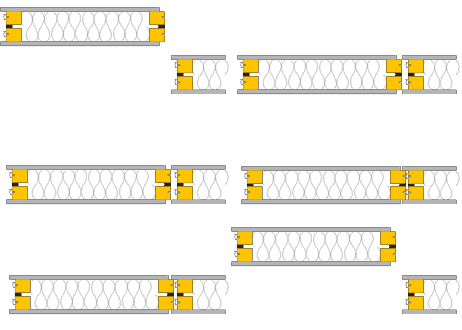
Each ROSI acoustic element has a double-shell construction. The outer and inner shells are connected by decoupled frames. Once the cabin is assembled, tongue and groove joints and double seals at the joints ensure the highest degree of tightness of the assembled acoustic booth.
The elements are joined together using toggle locks. However, we can also build your desired cabin with mostly "invisible" metal clasps. Further details are available upon request.
Doors and windows
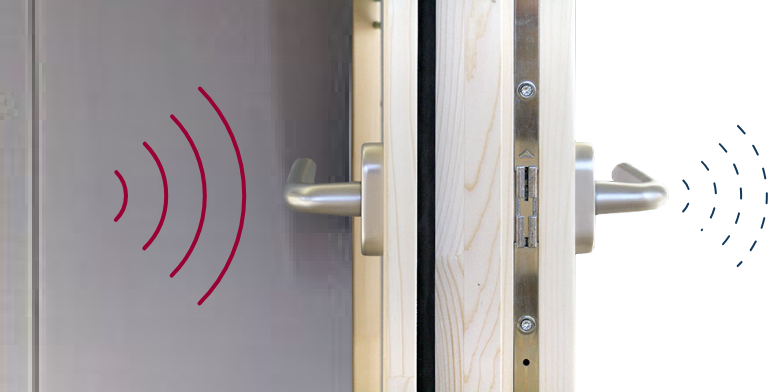
The door - a STUDIOBOX design - is matched to the modules. Double folds with all-round seals and a quadruple locking system prevent unwanted noise from passing through.
The windows are double-glazed with panes of different thicknesses; the panes are decoupled from the frame with foam rubber bands. Thus, the quality of sound insulation - tested by the Fraunhofer Institute - is just as high for glass modules as for solid wall elements.
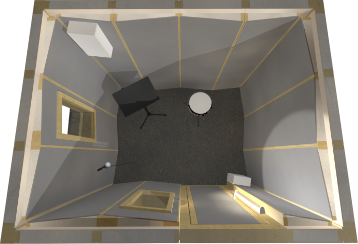
ROSI = STUDIOBOX quality features

- Double-shell wall element
- Floor construction, oscillating mounting
- Acoustic door (in-house development)
- High sound diversion due to effective element connections
- Sound-insulated ventilation system
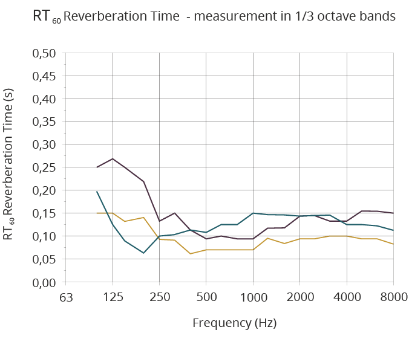
Measurement of a single element in the laboratory
R and Rw are only laboratory values for visualising the sound insulation quality of a component. Here, a single acoustic element is measured in the door test frame of the acoustic laboratory.
These parameters provide information on the quality of the individual element, but not on that of the fully assembled sound insulation cabin.